
Your experienced BD people can research a target company, recognise their challenges, and build a narrative around the offering that fits their specific situation.
But preserving that knowledge and clarity in systematic proactive engagement is where companies with multiple strategic offerings hit a wall.
This post walks through what it takes to make this diagnostic messaging operational — how companies with multiple complex offerings build the logic that determines which one to lead with into bespoke AI workflows.
My own consultancy faces this exact challenge. I have three distinct service lines, each addressing a different problem for a different type of strategic service and solution provider.
I’ll demonstrate how this works in practice — showing how one account moves from raw research through diagnosis to a message that leads with the relevant offering.
Where and Why Generic Approaches Fail for Complex Offerings
For companies with multiple complex and distinct offerings, sending a template listing all service lines is basically asking clients to do your work while also losing control of the perception they make of you.
They used to click through to your website and self-diagnose, but with automated outreach that behaviour has declined.
From my work, outreach that asks prospects to connect the dots for you normally results in 5x lower engagement rate.
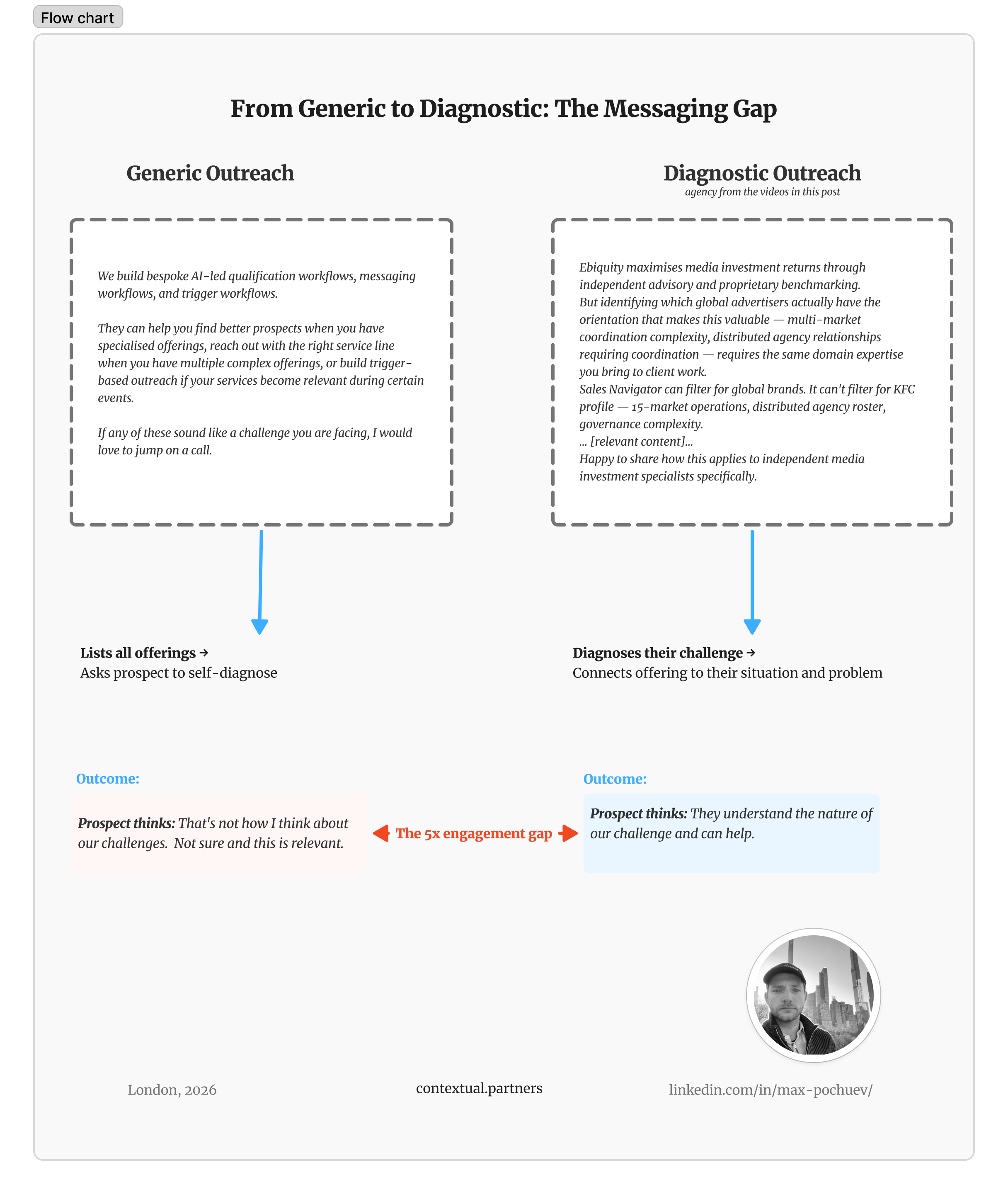
But this requires diagnosis — understanding enough about the prospect to determine which offering to lead with and why. Your senior people do this intuitively. But that judgment takes time and doesn’t transfer easily.
For companies with complex offerings where the right service or product depends on the prospect’s situation:
Automated generic templates ask prospects to do the diagnosis for you — which dramatically increases the friction, while also increasing the chance of wrong perception.
Handover to execution — junior team, VA, outsourced BD — increases volume but loses diagnostic depth. The issue is that without domain expertise, the person executing can’t recognise which patterns matter or which offering fits, resulting in the same results as automated static templates about the value prop.
AI personalisation tools pull LinkedIn posts, company news, and podcast appearances into openers. This earns a moment of attention, but if prospect’s recent post or campaign doesn’t connect to their needs it doesn’t demonstrate you understand why your offering matters to their situation.
These approaches fail for the same reason: they can’t encode the diagnostic logic that determines account challenges specific to your services and which offering fits which situation.
That logic is domain-specific. It lives in experienced heads. And without it, any execution — human or AI — defaults to generic.
Demonstrating Diagnostic Messaging in Practice
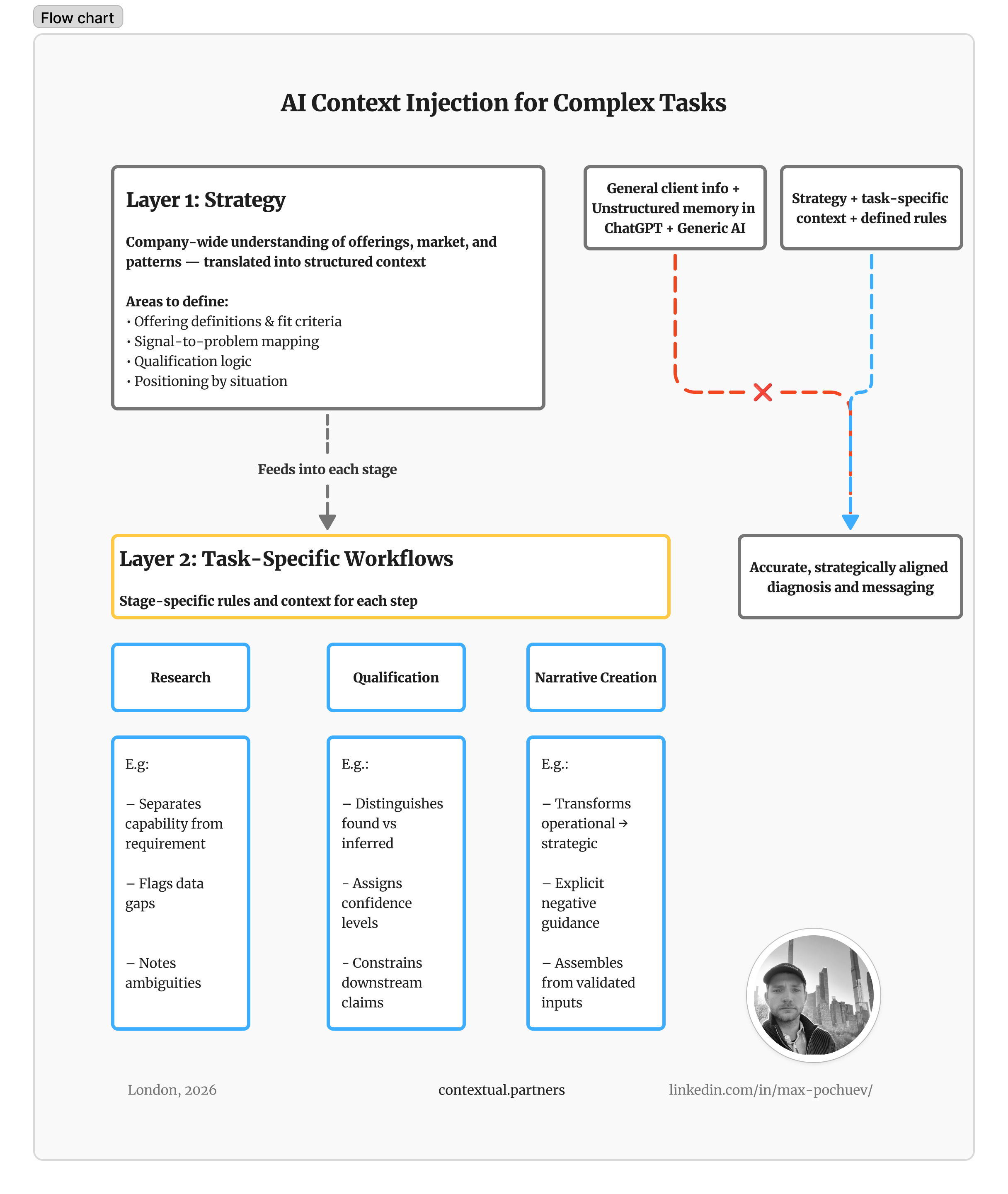
Even for complex client analysis, LLMs are capable of delivering strategically aligned results — but they require extensive context about you as a company, and more importantly, guidance on the specific task you’re applying them for.
To be clear — this isn’t adding company information to ChatGPT memories or just writing longer prompts. For complex, knowledge-based tasks, context injection involves building purpose-built datasets and decision-making frameworks and rules for each stage of a process.
The best way of getting there based on what I’m seeing is splitting the work in two layers:
First, sharpening and capturing your strategy: what makes an account a genuine fit for each offering, what signals indicate which problem they’re likely facing, what determines which angle to lead with. This is strategy work — company-wide clarity on the offerings, the market, the patterns experienced BD people recognise intuitively, captured into structured context that guides the workflow.
Second, translating that logic into task-specific rules and context datasets or files to build workflows that preserve complex decision-making.
Before I reach out to any company, I need to answer a diagnostic question: which of my service lines — if any — addresses a genuine challenge they’re facing?
The companies I work with typically fall into one of three situations:
They have a qualification problem — they know their ideal client profile but can’t identify those accounts systematically
They have a messaging problem — they have multiple offerings and can’t determine the right angle for each account
They have a timing problem — their services become relevant around specific-to-the-offering events, but they’re not catching those triggers
Each requires a different service line and different narrative. Generic outreach would list all three. Relevant outreach diagnoses which one matters — or recognises when none do, which is the case in around 85% of companies from a top-line “advertising services” Sales Navigator filter.
What Makes the Diagnosis Work
Achieving accurate AI-led diagnosis requires clear rules and priorities at each stage — what to look for, what to trust, what to validate before passing downstream, and what to explicitly avoid.
For my research stage, the rules ensure the relevant-to-my-offerings data is captured in a way that prevents downstream errors. In my case for determining GTM challenges it’s separating what the company can do from what their clients need, flagging gaps in the data and noting ambiguities. For your company and growth priorities, these rules and context will be very different.
For the qualification stage, the context encodes validation logic. It distinguishes between signals that have direct evidence and signals that are inferred. It also assigns confidence levels that constrain what downstream (i.e. narrative creation) stages can claim.
These rules and context came from my own work — learnings about what leads to accurate diagnosis and what leads to errors.
The two videos that follow show this process end-to-end for a single account. The first shows how research data becomes validated diagnosis — what the system looks for, what it trusts, what it flags. The second shows how that diagnosis becomes messaging inputs — the transformation from operational signals to strategic framing, including what the messaging is explicitly told not to say.
What This Enables
When the diagnosis is validated upstream, downstream narrative creation stages can produce accurate output without hallucination.
The next stage receives a diagnosis with explicit guidance: which signals to trust, which to treat with caution, what confidence level applies. It transforms this into messaging inputs — not by making strategic judgments, but by applying rules that have already been validated.
Following the example from the videos, it’s framing what prospects ARE rather than what they NEED — avoiding the circular logic or generic claims that make outreach sound like it was written by someone who doesn’t understand the space and their problem. The messaging reads as peer-to-peer, not sales pitch.
According to the defined rules, the messaging template doesn’t need to figure out which offering matters or what to emphasise.
The hard work — organising the process, building rules for strategic diagnosis, validation, transformation, constraints — happened before the message was written.
This precision — in diagnosis, in what to emphasise, in what to avoid — is what closes the engagement gap between generic outreach and messaging that demonstrates genuine understanding.
What Changes When Diagnostic Logic Becomes Operational
The shift isn’t about sending more emails or automating more touchpoints. It’s about where your senior BD people spend their time.
When diagnostic logic is encoded into workflows, the research and synthesis that used to consume senior hours happens systematically. The output isn’t generic templates with variables swapped — it’s messaging that reflects genuine understanding of why your offering matters to each account’s situation.
Senior time moves to what actually drives pipeline: applying insights, building relationships, converting conversations. The goal isn’t to replacing people. It’s to empower them to do more of the work that creates actual impact.
For complex and strategic offerings, this isn’t a straightforward implementation project. It’s not set-it-and-forget-it.
Building the context and frameworks that enable accurate diagnosis requires consultative work upfront — understanding the offerings deeply, identifying what signals actually indicate fit, encoding the validation logic that catches errors before they cascade. Establishing the foundation plus learnings from patterns on average takes at least a month.
And the system requires ongoing refinement as offerings evolve, markets shift, and new patterns emerge from outreach results.
But this investment unlocks significant value because it delivers results:
Diagnostic depth applied at scale — 5x increase in engagement rate
Messaging that’s accurate to the prospect’s situation, not hallucinated from generic patterns
Senior capacity freed for relationship building that closes deals
If your team’s diagnostic logic stays locked in senior heads and manual processes, you’re choosing between strategic depth that doesn’t scale and execution that doesn’t convert.
My work focuses on translating domain expertise into systematic workflows. If you have clarity on which offerings fit which client situations and want to explore what a diagnostic workflow could look like for your specific positioning — get in touch.